Showing posts with label Crow. Show all posts

Monday, March 11, 2013

More Than A Bird Brain: The Crow

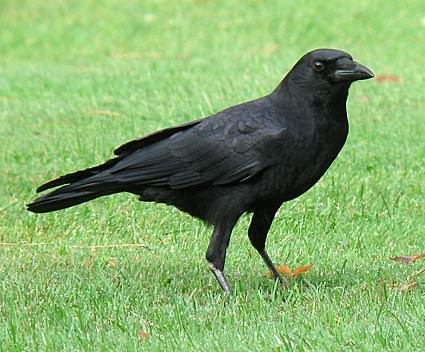
The American Crow
Photo from All About Birds
The crow doesn't seem all that impressive on the surface. Sporting an all-black coloration, the American Crow stands at only 44 cm (17.5 in) [1] and even has a dry, raspy caw that is neither pretty nor seems to draw much attention.

In pop-culture they are portrayed as either trash-birds or harbingers of death and disaster. Just think of the last zombie movie you saw.

But under their glossy black coat, crows are not only impressive, but mystifying. They are some of the smartest birds on the planet (one species may be THE smartest bird) and they are social animals that work and even raise families together. In other words, we share some traits in common.

Crows form closely-knit family groups. They are monogamous, faithful to their spouse, and even the crow-children stay close to the home. Many will forgo an opportunity to try to start a family of their own in order to help raise their brothers or sisters [2]. And their social personalities are not limited to their household. Crows stick together in large groups to forage for food. These groups can be big. Very big. A single flock of crows, known as a murder (pop-culture strikes again) can include well over a million individual birds, sometimes up to two million [3].

These impressive gatherings can usually be found around human settlements. American Crows are notorious for their ability to thrive in the conditions we create. Like humans, crows enjoy open landscapes with a few trees and perches, making our parks, cities and towns perfect ideal. Our commonalities with crows may go all the way back to a time when both species were foragers.

Crows played an important role in early human culture throughout the world. Thriving on carrion, crows could be found feeding on the recently deceased, linking them in many people's mind to the afterlife and religion. But crows feeding habits connected them to us in more ways than one. Humans are social, and group hunters, and crows undoubtedly grew close to us, knowing we could provide them with delicious scraps [4].

That kind of adaptability is what crows are famous for. Crows are incredibly smart, and American Crows is particularly talented in at least one respect: face recognition.

In a 2006 study, researchers the University of Washington captured crows, tagging them for later identification, all while wearing a mask. Recording the response of those crows later, they found that they reacted very little to researchers without the mask, but became aggressive when the researchers had the mask on, sometimes even diving at the researchers. The same response even came when different people wore the mask, indicating that it was indeed the face that they recognized [5]. What they also found was that crows that weren't originally caught responded in the same way. Crows could spread that knowledge through their avian society telling each other which humans were dangerous [4].

But they can indicate more than just warnings to each other. After walnut trees were planted in Japan, Japanese Crows began to take the hard-to-crack shells and place them behind the tires of parked cars or in the street. The cars would drive over them, Crrack, and crows would pick up their nutty profit.

This technique did not pop-up randomly either. It began in one small area of the city, with maybe one or two crows, and was gradually recorded father and farther out. a wave of knowledge from crow-to-crow spreading throughout Tokyo [4].

But arguably the most famous of all crow species is not from America, or Japan, but New Caledonia, a small tropical island off the coast of eastern Australia. The New Caledonian Crow might not be an everyday animal, but I would be remiss if  I didn't talk about them in a crow post.

An amazing feat by a New Caledonian Crow.
Photo from BBC
The New Caledonian Crow is possibly the smartest bird in the world, and maybe one of the smartest animals period. To get at tasty insects, the bird picked up a useful skill: it has learned to use tools. More than that, they have learned to create tools.

The crows can pick up sticks and sharpen them or bend them to solve the problem as they see fit. In a famous behavioral study from Oxford, New Caledonian Crows had to lift up a weight with a handle from the bottom of a long tube, and were given only long, thin, straight wires to do it with. The crows, upon discovering that straight wires could not help them, bent the wire into a hook, and hooked and lifted the weight [6]. Such cognitive abilities are unique among birds and are much greater than many primates, and even better than some human children.

More recent studies indicate that the New Caledonian Crows may even have knowledge or ideas of things that they cannot see, much as we do about microbes, atoms, and even gods [7].

Where ever they are located, crows around the world are social, highly intelligent and perhaps deserving of more respect than people give them. But they are still hunted in large numbers, and although some species such as the American Crow is doing well, others like the Northwest Crow and the Hawaiian Crow may have already gone extinct.

So the next time you see a crow in the street, or in the park, or nibbling on some trash, don't be so quick to dismiss it. Stop, give a thought to it's complexity, its resourcefulness, and its adaptability, and then be on your way.


For more on crows, crow studies, and the amazing-ness that is crows, here are some great videos:

Note: because I have linked my sources in the post itself I will no longer be posting them separately afterwords as well. Similarly because I have posted links to the pictures used I will no longer be posting that separately. If you have thoughts on this or you would like to see these sources added back to the bottom of every post, please leave a comment below.


Saturday, March 2, 2013

What's the Difference: Crows and Ravens

A crow and a raven, respectively.
photo by Gerrett Lau
You see a black bird flying overhead in the middle of a crowded street. Is it a raven? A crow? How can you tell? Should you care? Absolutely. Crows and ravens may seem like ordinary birds but they are anything but. To those in the know, they are clever, mischievousness, successful and frighteningly intelligent animals.

But your confusion is understandable, after all they are both sleek black birds that you see everywhere and they are very closely related; both belong to the genus Corvus. Many species of Corvus exist throughout the U.S. but on the west coast you are probably most familiar with: The American Crow (Corvus brachyrhynchos) and the common raven (Corvus corax[1][2].

The American Crow is a highly sociable bird and can form enormous flocks (lovingly known as "murders") that can include over a million individuals. The American Crow is significantly smaller than the common raven but, not to be outdone, it uses its larger numbers for success in both breeding and hunting.

Crows are monogamous but often form large family groups where older offspring help parents take care of the new chicks; sometimes staying with the parents for many years. 15 birds to a nest is not uncommon [3][4]. Each individual helps provide food and care for the family, and they work as a team to acquire food. Teams of cunning crows have been known to distract predators while another crow sneaks in from behind to steal the predator's hard-earned meal [5]. This is all to say that if the black bird you see is one just one in a flock, you can be fairly certain it is a crow.

Ravens on the other-hand live a more solitary life. They can form mating pairs, but it is rare to see more than two together [5]. But like crows the ravens can work together to get prey and are extremely clever at finding food, but their size is less of a factor. Common ravens are the largest of all American corvids, and its one of the primary ways they can be distinguished. Ravens also prefer woodlands, open-landscapes, and mountainous areas to cities and towns. Ravens are not uncommon in urban areas, but they do not seem to have the affinity for human settlement that crows do [6].

But like everything in nature, exceptions are all to common. Common ravens can occasionally be seen in large flocks in the cities, and crows can be seen all alone in the forest. When you are unsure, beaks and tails are tell-tail signs (see what I did there?). Ravens sport a wedge-shaped tail and a longer, heftier beak. They also sport distinctive neck plumage when they call. This is opposed to the squarer tail and smaller, rounder beak of the American Crow [7][8]. Still unsure? Look for it's flight pattern. If it is performing acrobatic tricks, its probably a raven.

While crows flap almost continuously in flight, ravens are known to glide for long periods and take this time to show off mid-air stunts. famous for their aerial acrobatics, a raven was even recorded flying upside down for more than half a mile. Quick dives up and down, somersaults, and even dropping and catching objects in mid-flight are common sights if you pay attention when ravens fly by [5].

Their calls are also distinctive, and fitting to their body-type. The smaller American Crow's calls are higher pitched, and you can often hear many of them together. Their calls are probably the most familiar to you, the traditional caw-caw [9]. Common ravens have a deeper, harsher voice, and often can be heard alone [10]. But before you identify them on sound alone, you should know that both crows and ravens produce a variety of sounds and are notorious imitators; even mimicking human speech.

Up until now I have been hesitant about writing a crow or raven post. Not because their isn't enough to say about them, but because there is an intimidating amount. Intelligence on par or over some primates, these birds are extraordinary, and now that you know the difference you can look forward much more extensive posts on them coming soon. In the mean time let me know what animals you want know the difference between and keep up with animal facts and science news on my Twitter: @everydayanimal.

More information on the differences between crows and ravens:
http://birdnote.org/show/ravens-and-crows-who-who
http://www.youtube.com/watch?v=guBwMUAWAJI
http://www.allaboutbirds.org/page.aspx?pid=2501


Sources:
[1] http://www.allaboutbirds.org/guide/American_Crow/lifehistory
[2] http://www.allaboutbirds.org/guide/common_raven/id
[3] http://www.birdweb.org/birdweb/bird/american_crow
[4] http://www.news.cornell.edu/chronicle/97/4.10.97/crow.html
[5] http://www.allaboutbirds.org/guide/common_raven/lifehistory#at_nesting
[6] http://www.birdweb.org/birdweb/bird/common_raven
[7] http://animals.nationalgeographic.com/animals/birding/common-raven/
[8] http://animals.nationalgeographic.com/animals/birding/american-crow/
[9] http://www.allaboutbirds.org/guide/American_Crow/sounds
[10] http://www.allaboutbirds.org/guide/common_raven/sounds

Photo by Garrett Lau from:
http://birdnote.org/show/ravens-and-crows-who-who